Accessibility links

Breaking News

Armenia, Azerbaijan Trade Accusations Of Breaking Cease-Fire, Fighting Reported Near Iranian Border

Armenian reservists undergo military training before leaving for the front line in Nagorno-Karabakh on October 27.

Armenia and Azerbaijan have exchanged blame for the collapse of a U.S.-brokered cease-fire as a month-long war over the separatist Nagorno-Karabakh region intensified near the border with Iran.

BAKU/YEREVAN -- Armenia and Azerbaijan have exchanged blame for the collapse of a U.S.-brokered cease-fire as a month-long war over the separatist Nagorno-Karabakh region intensified near the border with Iran.

U.S. Secretary of State Mike Pompeo called on the leaders of Azerbaijan and Armenia on October 27 to abide by the cease-fire, which collapsed minutes after it was meant to go into effect the day before.

In separate phone calls with Armenian Prime Minister Nikol Pashinian and Azerbaijani President Ilham Aliyev, Pompeo "pressed the leaders to abide by their commitments to cease hostilities and pursue a diplomatic solution to the Nagorno-Karabakh conflict," the State Department said.

He also told the two leaders that "there is no military solution to this conflict," the State Department said.

Fighting was reported along several parts of the front line on October 27, with heavy clashes reported in the southern sector near the border with Iran.

Armenia accused Azerbaijan of using drones and artillery to strike border guard positions along its internationally recognized border in the southeast near Iran, compelling Armenian forces to strike back.

Azerbaijan denied violating the cease-fire in the area, accusing Armenian forces of firing mortars at its positions in Zangilan, Khojavend, Fizuli, and Gubadli on the southern front near the border with Iran.

Armenian Defense Ministry official Artsrun Hovhannisian said in a news conference late on October 26 that ethnic Armenian forces had given up the settlement of Gubadli, which lies south of the enclave and just seven kilometers from the Armenian border.

He said the settlement was given up "to avoid unnecessary losses," but the situation was "not critical."

Meanwhile, the head of Karabakh’s Armenia-backed defense forces, Lieutenant General Jalal Harutiunian, was replaced after reportedly being wounded in action.

Azerbaijan also accused Armenian forces of shelling the Azerbaijani town of Tartar and adjacent villages in the north.

"Armenian armed forces during the day on October 26 and overnight into October 27 fired at the positions of Azerbaijani Army units in different directions at the front and at our settlements near the front line with various weapons," the Azerbaijani Defense Ministry said in a statement.
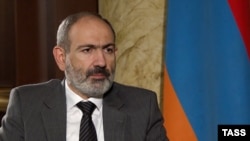
Armenian Prime Minister Nikol Pashinian

Pashinian said the cease-fire had collapsed.

"I would like to state that the efforts of the international community, this time brokered by the United States, to establish a cease-fire, have failed. As a result of continuous shelling by Azerbaijan, civilians were killed and wounded in Artsakh (the Armenian name for Nagorno-Karabakh) today," Pashinian said on Twitter on October 27.

Meanwhile, the Azerbaijani Defense Ministry on October 27 claimed it was Armenia that has failed to comply with the humanitarian cease-fire.

"Armenian armed forces during the day on October 26 and overnight into October 27 fired at the positions of Azerbaijani army units in different directions at the front and at our settlements near the front line with various weapons. The fighting continued mainly in the frontline directions of Khojavend, Fizuli, and Gubadli," the ministry said in a statement, adding Azerbaijani forces had fought off the attacks.
A Bitter Past: Memories Of Old Conflict Make Peace Elusive In Nagorno-Karabakh
please wait

No media source currently available

0:00 0:03:49 0:00

The cease-fire was announced in a joint statement from the U.S. State Department and the two governments on October 25 -- the third attempt to establish a pause in the hostilities that broke out on September 27.

Two previous Russian-brokered cease-fires also collapsed soon after being agreed upon.

Ethnic tensions in the region between Christian Armenians and their mainly Muslim neighbors have flared in Nagorno-Karabakh for decades.

Under international law, Nagorno-Karabakh is recognized as part of Azerbaijan, but the ethnic Armenians, who make up the vast majority of the population, reject Azerbaijani rule. They have been governing their own affairs, with support from Armenia, since Azerbaijan's troops were pushed out of the breakaway region in a war in the 1990s.
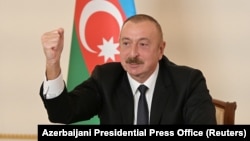
Azerbaijani President Ilham Aliyev gestures as he speaks during an address to the nation in Baku on October 26.

Azerbaijani President Ilham Aliyev said in an address to the nation on October 26 that Azerbaijan wanted to resolve the conflict over Nagorno-Karabakh either by political or military means.

He also reiterated a demand that that Nagorno-Karabakh be returned to Azerbaijan along with seven surrounding districts controlled by Armenian forces.

The United States, France, and Russia -- co-chairs of the Minsk Group of the Organization for Security and Cooperation in Europe (OSCE) -- said its foreign ministers would meet on October 29 in Geneva to discuss the Nagorno-Karabakh issue.

The Minsk Group, formed to mediate the conflict, said the meeting would "discuss, reach agreement on, and begin implementation, in accordance with a timeline to be agreed upon, of all steps necessary to achieve a peaceful settlement of the Nagorno-Karabakh conflict."

Turkey has demanded a bigger role in the mediating body.

'Everyone Needs To Fight': The Village Volunteers Of The Karabakh War

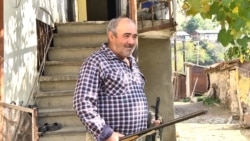
Ethnic Armenian men with Soviet-made weapons in a village in Nagorno-Karabakh -- a breakaway region which is internationally recognized as part of Azerbaijan -- on October 23.<br />
&nbsp;
1/9 Ethnic Armenian men with Soviet-made weapons in a village in Nagorno-Karabakh -- a breakaway region which is internationally recognized as part of Azerbaijan -- on October 23.
 
Ethnic Armenians near the front lines of the conflict in Nagorno-Karabakh are taking up arms against the Azerbaijani military.
A volunteer fighter with a Christian cross and the letters of the<a href="https://en.wikipedia.org/wiki/Armenian_Revolutionary_Federation" target="_blank"> Armenian Revolutionary Federation </a>on his weapon stands ready.<br />
&nbsp;<br />
The ARF is a nationalist political party that was formed in the Ottoman Empire in the 1890s with the reported aim of &ldquo;defending Armenian villages from massacres that were widespread in some of the Armenian-populated areas of the empire.&rdquo;
2/9 A volunteer fighter with a Christian cross and the letters of the Armenian Revolutionary Federation on his weapon stands ready.
 
The ARF is a nationalist political party that was formed in the Ottoman Empire in the 1890s with the reported aim of “defending Armenian villages from massacres that were widespread in some of the Armenian-populated areas of the empire.”
Ethnic Armenians near the front lines of the conflict in Nagorno-Karabakh are taking up arms against the Azerbaijani military.
A man from another group of armed ethnic Armenian volunteers in the village of Avetarnots on October 25.
3/9 A man from another group of armed ethnic Armenian volunteers in the village of Avetarnots on October 25.
Ethnic Armenians near the front lines of the conflict in Nagorno-Karabakh are taking up arms against the Azerbaijani military.
A militiaman walks on an empty road in Avetarnots, 14 kilometers from Stepanakert, the largest city in Nagorno-Karabakh.
4/9 A militiaman walks on an empty road in Avetarnots, 14 kilometers from Stepanakert, the largest city in Nagorno-Karabakh.
Ethnic Armenians near the front lines of the conflict in Nagorno-Karabakh are taking up arms against the Azerbaijani military.
Armed volunteers relax at an undisclosed location south of Stepanakert.<br />
&nbsp;<br />
Armenia has a long history of armed volunteers signing up to fight in the country&#39;s wars.
5/9 Armed volunteers relax at an undisclosed location south of Stepanakert.
 
Armenia has a long history of armed volunteers signing up to fight in the country's wars.
Ethnic Armenians near the front lines of the conflict in Nagorno-Karabakh are taking up arms against the Azerbaijani military.
A volunteer fighter gestures in Avetarnots.<br />
&nbsp;<br />
Groups who formed volunteer battalions to defend Armenian civilians and disrupt Ottoman rule in the 1890s <a href="https://en.wikipedia.org/wiki/Armenian_fedayi">were known as &ldquo;Fedayi,&rdquo;</a>&nbsp;which is derived from a similar Arabic word meaning &ldquo;to sacrifice.&rdquo;<br />
&nbsp;
6/9 A volunteer fighter gestures in Avetarnots.
 
Groups who formed volunteer battalions to defend Armenian civilians and disrupt Ottoman rule in the 1890s were known as “Fedayi,” which is derived from a similar Arabic word meaning “to sacrifice.”
 
Ethnic Armenians near the front lines of the conflict in Nagorno-Karabakh are taking up arms against the Azerbaijani military.
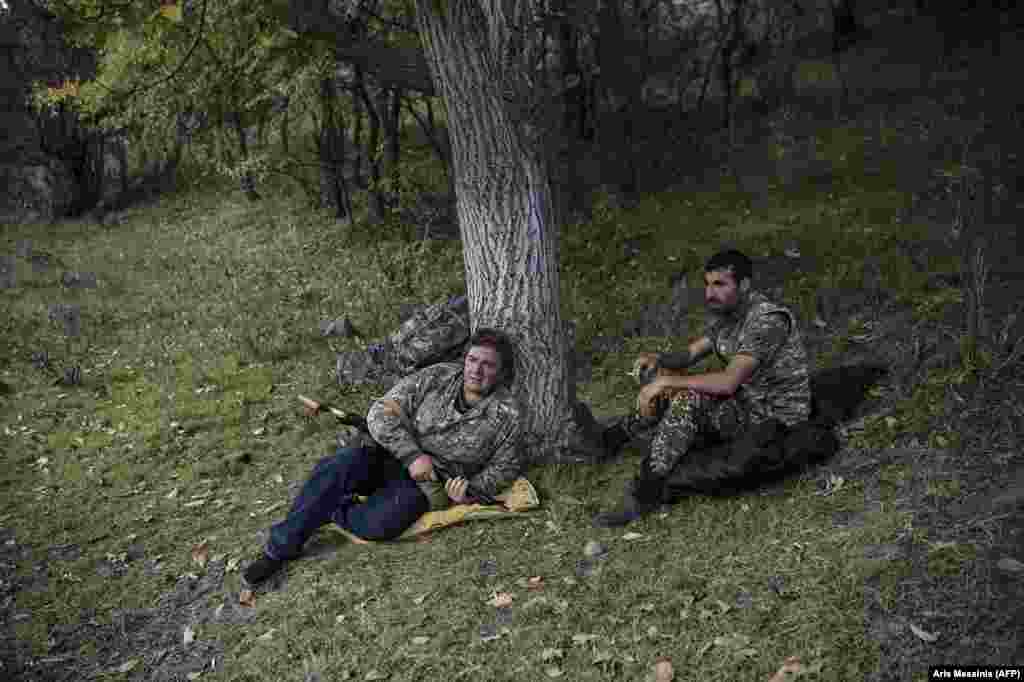
Ethnic Armenian gunmen rest in a village south of Stepanakert.<br />
&nbsp;<br />
In August 2020, just before the latest hostilities broke out, lawmaker Sasun Mikaelian <a href="https://www.azatutyun.am/a/30803803.html">called for a formal volunteer militia</a> to be formed to supplement Armenia&rsquo;s military. Mikaelian said such a militia was necessary because Armenia was &ldquo;surrounded by enemies.&rdquo;<br />
&nbsp;
7/9 Ethnic Armenian gunmen rest in a village south of Stepanakert.
 
In August 2020, just before the latest hostilities broke out, lawmaker Sasun Mikaelian called for a formal volunteer militia to be formed to supplement Armenia’s military. Mikaelian said such a militia was necessary because Armenia was “surrounded by enemies.”
 
Ethnic Armenians near the front lines of the conflict in Nagorno-Karabakh are taking up arms against the Azerbaijani military.
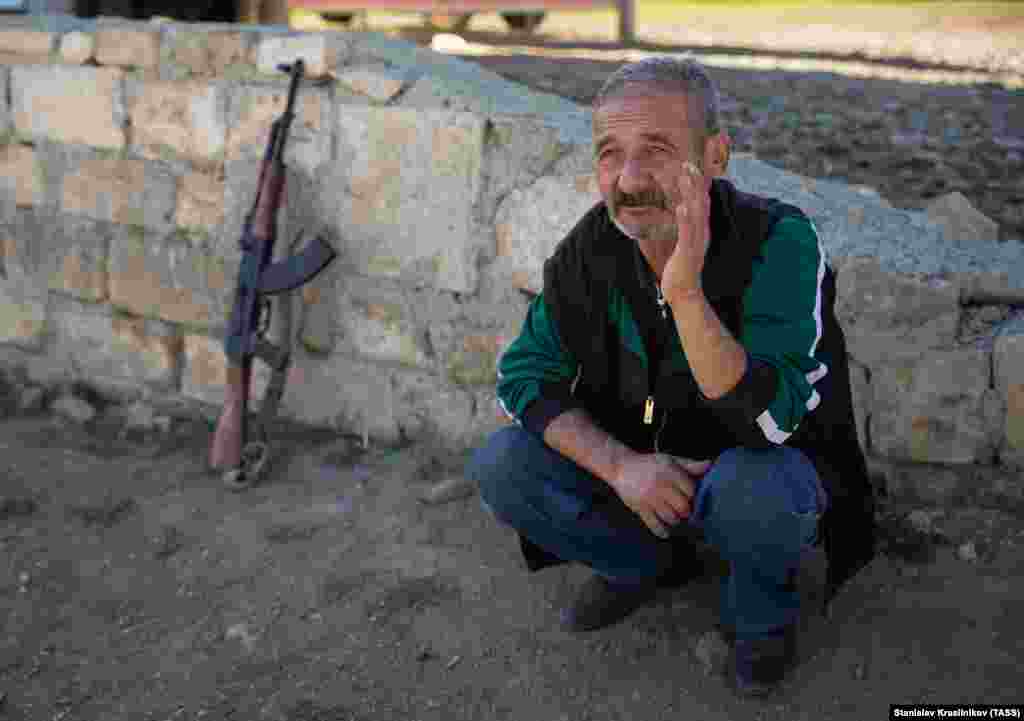
An elderly ethnic Armenian sits next to his weapon in Avetarnots.<br />
&nbsp;<br />
Some combatants in the current conflict have dusted off old weapons stored in their homes and last used in the Nagorno-Karabakh War that ended in 1994.
8/9 An elderly ethnic Armenian sits next to his weapon in Avetarnots.
 
Some combatants in the current conflict have dusted off old weapons stored in their homes and last used in the Nagorno-Karabakh War that ended in 1994.
Ethnic Armenians near the front lines of the conflict in Nagorno-Karabakh are taking up arms against the Azerbaijani military.
A volunteer fighter strolls near a village south of Stepanakert.<br />
&nbsp;<br />
In early October, a volunteer fighter <a href="https://www.bangkokpost.com/world/1997639/everyone-needs-to-fight-armenian-recruits-flock-to-karabakh" target="_blank">told AFP</a>: &quot;We are a small nation and we don&#39;t have any other alternative but to win. This is why everyone needs to fight.&quot;
9/9 A volunteer fighter strolls near a village south of Stepanakert.
 
In early October, a volunteer fighter told AFP: "We are a small nation and we don't have any other alternative but to win. This is why everyone needs to fight."
Ethnic Armenians near the front lines of the conflict in Nagorno-Karabakh are taking up arms against the Azerbaijani military.
Previous slide
Next slide

At least some 1,000 people have been reported killed since fighting erupted on September 27, raising fears of a wider conflict in the South Caucasus drawing in NATO member Turkey, which is an ally of Azerbaijan, and Russia, which has a military pact with Armenia.

Armenian forces and the Azerbaijani's military claim to have inflicted devastating losses on each other.

But reports from the opposing sides are often contradictory and hard to verify.

Russian President Vladimir Putin said on October 22 that Moscow believes nearly 5,000 people have been killed in the latest fighting.

With reporting by Reuters, AFP, and TASS
XS
SM
MD
LG